Avast ye!
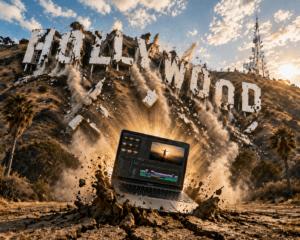
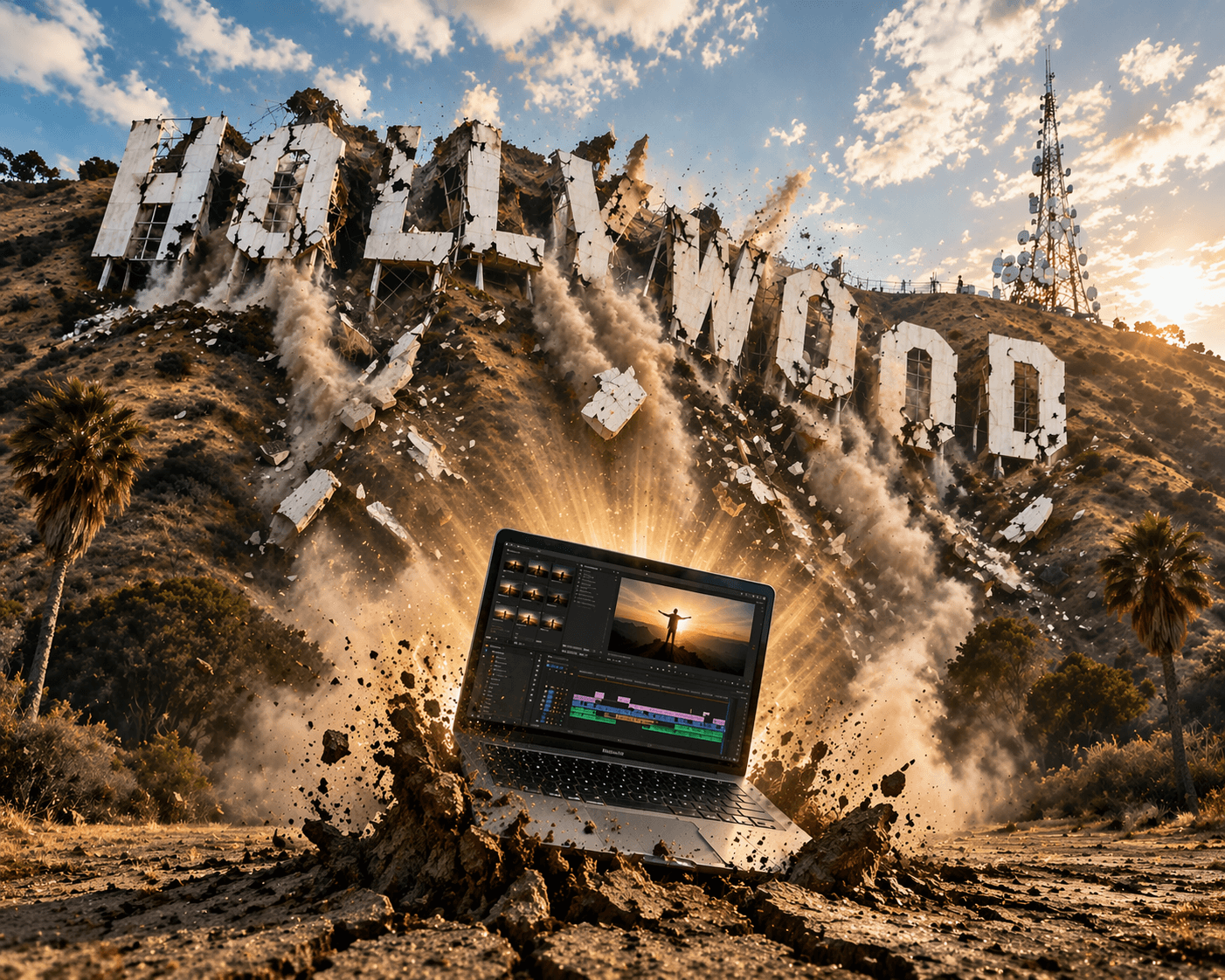
Drop the anchor and look at the Hollywood Hills. The old empire is burning.
For the last century, visual storytelling has been guarded by a massive, impenetrable moat of capital. If you wanted to write a book, you just needed a pen. If you wanted to record a song, you just needed a microphone. But if you wanted to produce a high-end commercial or a cinematic feature film, you needed an army. You needed a 200-person crew, union contracts, craft services, permits to shut down city streets, $50,000 RED cameras, and a post-production VFX house.
The traditional studio system operated as a monopoly on high-fidelity visuals because no single individual could afford the hardware or the manpower to compete.
In mid-April 2026, that monopoly has collapsed. The studio is no longer a sprawling physical lot in Burbank; it is a single laptop on a kitchen table.
We are living through the Great Democratization of visual media. With the explosive maturation of generative video models, a solo creator sitting in a home office can now conjure sweeping, photorealistic cinematic worlds entirely from text. They do not need a green light from a studio executive. They do not need venture capital. They just need a prompt.
Today, we are analyzing the devastating AI impact on film industry 2026 economics. We are looking at why massive advertising budgets are abandoning traditional production houses, and why the “Solo Director” is rapidly becoming the most dangerous force in entertainment.
Let’s survey the new landscape.
The News Hook: The Q1 2026 Ad Budget Exodus
If you want to know when an industry is truly dying, don’t listen to the artists; follow the advertising money.
In Q1 2026, the corporate earnings reports revealed a massive, undeniable shift in how global brands allocate their commercial production budgets. Historically, a Fortune 500 company would hand a $2 million contract to an elite creative agency in New York or London. That agency would then subcontract massive production crews to physically film the campaign over several months.
Today, those brands are quietly moving those exact same budgets to “AI-Native” agencies—agencies that are often run by a single, highly leveraged solo operator.
💡Captain’s Log / Personal Note:
I used to hire a boutique video editing agency out of Seattle to produce the high-end promotional trailers for my AICashCaptain digital products. They charged me roughly $3,500 for a 45-second promo, and the turnaround time was three agonizing weeks of revisions. Last month, I decided to test the new visual frontier. I locked my office door, queued up a 90s hip-hop playlist on my dedicated 128GB AiMoonsa MP3 player to block out all external distractions, and generated the entire storyboard using my local Llama 3.1 rig. I fed those prompts directly into Runway Gen-3. I had a breathtaking, hyper-realistic, 4k promo video rendered and finalized in exactly 45 minutes. It cost me absolutely zero dollars in external labor. My former agency cannot mathematically compete with that.
The European film sector is already sounding the alarm. According to a recent, highly publicized report by the European Film Agency Directors (EFAD) and France’s National Centre for Cinema (CNC), 90% of audiovisual professionals are already heavily using AI to survive, but the union secretaries are noting that “junior jobs are disappearing entirely: all the assistant editors, assistant screenwriters, and set designers.”
This isn’t a future prediction; it is current data. The UK’s CoSTAR Foresight Lab on AI in the Screen Sector has explicitly warned that unless traditional studios radically restructure, they will be outpaced globally by a new breed of hyper-agile, AI-native solo studios that operate with virtually zero overhead.
When the friction of physical production drops to zero, the barrier to entry vanishes, and the old guard panics.
The Economics of Immortality: $500k vs. $50
To truly grasp the magnitude of this extinction-level event, you must look at the brutal unit economics of the modern commercial. Let’s examine the quintessential Hollywood cash cow: the high-end automotive commercial.
The 2024 Physical Production Model
Two years ago, if a major brand wanted to film a sleek SUV driving through a rugged, snowy mountain pass, the baseline cost was roughly $500,000.
- The Logistics: You had to pay the local government for permits to shut down a physical mountain road for three days.
- The Crew: You had to hire a precision stunt driver, a helicopter pilot for aerial tracking shots, a Director of Photography, grip and lighting teams, and catering to feed 60 people on a freezing mountain.
- The Risk: If it rained on the wrong day, or the drone crashed, the shoot was delayed, costing tens of thousands of dollars in union overtime.
The 2026 Synthetic Production Model
Today, a Solo Director executing an AI-generated car commercial requires exactly three things: a subscription to Midjourney for storyboarding, an API key for OpenAI’s Sora to simulate the driving physics, and an ElevenLabs account for the cinematic voiceover.
The total cost is a $30 monthly software subscription and about $20 in electricity to run the laptop. Total: $50.
We are no longer speaking in hypotheticals. As cataloged by digital marketing analysts at JZ Creates’ breakdown of the AI Commercial Revolution, solo operators are routinely generating Lincoln and Porsche spec ads using Runway Gen-3 that are completely indistinguishable from real life. The AI perfectly understands the physics of how light reflects off metallic paint, how snow kicks up behind rubber tires, and how a cinematic drone tracking shot should pace itself.
💡Captain’s Log / Personal Note:
The most profound realization I had during this transition wasn’t about the money saved; it was about the speed of iteration. In a traditional workflow, if you decide the car should be red instead of black, you have to literally reshoot the video or spend a fortune in post-production VFX. When I am rendering automated cinematic b-roll for my faceless YouTube channels now, if I don’t like the color of the car, I literally change one word in my text prompt and re-render the entire 10-second clip in two minutes. The iteration cycle has been compressed from weeks to milliseconds.
This pricing gap is insurmountable. According to the foundational theories of Harvard Business Review’s Disruptive Innovation model, when a new technology offers a product that is “good enough” for a fraction of the traditional cost, it doesn’t just compete with the incumbents; it completely hollows out their business model from the bottom up.
Middle-tier production companies—the agencies that used to charge $50,000 to shoot local medical spa commercials or regional car dealership ads—are already extinct. They simply cannot justify their invoices to local business owners who know a 20-year-old solo director can generate a better-looking commercial from their dorm room for a tenth of the price.
The cameras are no longer rolling. The servers are processing. And the Solo Director is taking the throne.
The Creativity Unlock: When the Cost of Visuals Reaches Zero
For decades, the film industry operated under a strict delusion: they believed that massive budgets equaled brilliant storytelling. Because it cost millions of dollars just to put a camera on a crane and light a set, the studios assumed that only “approved” executives possessed the intellect to direct that money.
But when you remove the physical cost of production, you expose a terrifying truth for Hollywood: Execution is no longer a moat. Ideation is the only currency.
When generative AI tools like Sora, Runway, and Luma make photorealistic, 8k cinematic visuals functionally free, the technical playing field is instantly leveled. A 20-year-old in a basement has the exact same visual rendering capabilities as a multi-billion-dollar studio in Burbank.
When everyone has a $50,000 digital RED camera, the camera stops mattering. The only thing that matters is the Quality of the Idea.
This is the “Creativity Unlock.” In the legacy system, if an independent filmmaker had a brilliant, mind-bending sci-fi script, it would sit in a drawer forever because nobody would give them the $100 million needed to render the CGI spaceships. Today, that filmmaker does not ask for money; they just type the prompt.
According to a massive Goldman Sachs economic report on the Creator Economy, the market is projected to reach nearly half a trillion dollars by 2027, driven almost entirely by the decentralization of production tools. The wealth is shifting from massive, bureaucratic media conglomerates directly into the pockets of lean, fast-moving solo operators who can ideate and publish in the same afternoon.
💡Captain’s Log / Personal Note:
When I am deep in the “Synthetic Studio,” grinding out the architecture for a new cinematic video asset, my physical footprint is incredibly small, but my cognitive output is massive. I don’t have craft services or a massive crew to manage. I pop in a nicotine pouch for the sustained cognitive enhancement, lock my office door, and push my local hardware to the absolute limit. Just last week, I was completely bottlenecking my local GPU running LM Studio to generate the complex narrative script, while simultaneously prompting Runway Gen-3 in the browser to render the B-roll. It is an intense, high-focus flow state. I am acting as the writer, the director, and the editor all at once, fueled entirely by nicotine and computing power.
The Speed Advantage: 3 Years vs. 3 Hours
The modern consumer’s attention span moves at the speed of the internet. By the time a traditional Hollywood studio identifies a cultural trend, writes a script, casts the actors, films the movie, and runs it through a year of post-production VFX, the trend has been dead for 36 months. The studio releases a $200 million dinosaur that nobody cares about.
A Solo Director trend-jacks in real-time. If a new aesthetic or cultural obsession explodes on TikTok on a Tuesday, the Solo Director can write the script, generate the AI video assets, synthesize the voiceover, and publish a cinematic, highly relevant short film by Wednesday morning.
This agility is destroying legacy media. As documented in a sobering Hollywood Reporter article, major studio titans like Tyler Perry have literally halted $800 million physical studio expansions specifically because they saw the capabilities of OpenAI’s Sora. They realize that building physical soundstages in an era of digital world-building is a catastrophic misallocation of capital.
The Anatomy of the “Solo Studio” Stack
How exactly is one person replacing a 200-person film crew? They are chaining together hyper-specialized AI foundation models.
The 2026 Solo Director operates a pipeline that looks like this:
- The Writers Room: Instead of hiring five screenwriters, the director uses a locally hosted LLM (like Llama 3.1) or Claude to act as an interactive sounding board, generating dialogue and storyboarding scene transitions.
- The Storyboard Artist: The director uses Midjourney v7 to generate static, conceptual frames of the key scenes to lock in the aesthetic and color grading.
- The Cinematographer: The Midjourney frames are fed into Runway Gen-3 or Luma Dream Machine using “Image-to-Video” prompts, allowing the director to explicitly command the digital camera movements (panning, tracking, zooming).
- The Sound Stage: The director uses platforms like ElevenLabs for hyper-realistic, emotionally resonant voice acting, and Suno AI to generate original, cinematic orchestral scores that perfectly match the tempo of the edit.
In this ecosystem, the solo creator is not doing the manual labor of editing pixels or setting up lights. They are acting in the truest sense of the word “Director.” They are managing a team of digital savants, giving them instructions, and curating the final output.
For a deep dive into how these specific tools are being chained together by professional agencies, MIT Technology Review’s expansive coverage on Synthetic Media illustrates how the integration of text, audio, and video AI models is creating a completely frictionless production loop.
The Captain’s Verdict: Give Yourself the Green Light
For your entire life, society has told you that to do something massive, you need permission.
If you wanted to write a book, you needed a publisher to pick you. If you wanted to start a TV network, you needed a broadcasting license. And if you wanted to make a movie, you needed a studio executive in a corner office to hand you a $10 million check and give you the “green light.”
That era is dead. The gatekeepers have been slaughtered by the algorithm.
💡Captain’s Log / Personal Note:
I was having a beer with my buddy JP recently, and we were laughing at the absurdity of the timeline we live in. Ten years ago, if we wanted to shoot a cinematic trailer, we would have had to rent thousands of dollars worth of camera gear, beg our friends to act in it, and spend weeks editing choppy footage on an underpowered laptop. Now, we just type exactly what we want to see into a terminal, and a supercomputer paints it for us in sixty seconds. The excuse of “I don’t have the budget” has been permanently erased from the entrepreneurial dictionary.
Don’t wait for a green light from a studio executive. You are the studio. Give yourself the green light.
The most valuable skill in 2026 is no longer your ability to network at Hollywood parties. The most valuable skill is your ability to articulate a vision so clearly that a machine can build it for you. The creators who master the language of these models are going to build media empires that rival Disney and Netflix, and they are going to do it with zero full-time employees.
The Connection: The Keys to the Studio
The tools to build this empire are not locked in a corporate vault. They are sitting in your web browser right now.
On Monday, we did a massive, head-to-head teardown of the exact rendering engines you need to start producing this footage. We analyzed the cinematic control of Runway, the rapid generation speed of Luma, and the physics simulation of Sora.
If you want to know exactly which software subscription you need to buy today to launch your faceless channel, read the intelligence report here: Sora vs. Runway vs. Luma: Best Text to Video AI (2026).
Do not sit on the sidelines while the greatest wealth transfer in media history takes place. Grab the tools.
Conclusion: The Future of Film
Hollywood is terrified, and they should be.
They built a business model on the premise that producing high-quality video was impossibly hard and astronomically expensive. They relied on friction to protect their monopoly.
Generative AI is the ultimate friction-destroyer.
We are entering a golden age of visual storytelling, where the only limit to what you can put on a screen is the limit of your own imagination. You no longer need to compromise your script because a physical location is too expensive to rent. You no longer need to abandon a project because an actor drops out.
The barrier to scale has been destroyed. The Solo Director is no longer a scrappy underdog; they are an apex predator in the digital economy.
The cameras are off. The servers are on. Welcome to the future of film.
🔗 Related posts:
- Stop Wasting Credits: The 4-Part Formula for Perfect AI Video Prompts (2026)
- Stop Guessing What Sells: How to Use AI to Find Profitable E-Commerce Niches (2026)
- From Prompt to Profit: The Top 3 AI Tools for Your Print-on-Demand Empire (2026)
- Stop Cold Calling: The ‘Live Link’ Script to Land Your First $1,000/Month AI Client